
When I was a kid in the 80s, the Schwinn Varsity was the most popular 10 speed bike around. And that’s what we always called road bikes, 10 speeds. It was one of the best-selling models for Schwinn and has a long history. It was never a top-of-the-line bike, but it was affordable, durable, and reliable. And there are many still out there that are in good shape, and a good price. It was a nice affordable bike when made, and now it’s an affordable vintage bike. I’m going to cover this bikes history and specs.
Contents
History
The Varsity was first introduced in 1953, but as more of a cruiser bike. It was a typical 3-speed bike with upright bars and full fenders.

Schwinn considered it a 3-speed lightweight probably because it didn’t have the heavier cantilever frame of many other models. It was not very light at around 50lbs. It came as a men’s and ladies’ models with 26” and 24” tire options. 1956 was the last year for this version.
In 1960 it became the drop bar style road bike that most of us are familiar with.

It started as a men’s only model with 8-speeds, racing handlebars, and hooded caliper brakes. Sizes were 19, 21, and 23 inch. Rims were 26” with Schwinn tires and diamond steel frame.
Colors: Radiant red, blue, green, and black
Retail price: $69.95
Timeline
1962, it became a 10-speed with Huret derailleurs. Weight is about 40lbs.
1963, it changed to 27” wheels.
1965, it becomes the Varsity Sport and a model with chrome fenders is available.
1967, it now has Twin-Stik stem mounted shifters. Previous years had downtube shifters.
1972, they begin offering a 24” wheel kids version.

1975, chrome fenders become an option rather than a separate model.
1977, camelback frame become available.
1978, drops the Sport and become just the Varsity and offers ladies frames.

1979, become the Varsity Sport again.
1980, Deluxe Varsity is introduced. This version has front freewheeling FF system and positron shifting.
1982 was the last year for the Chicago made Varsity. The Varsity and Deluxe Varsity were offered. Schwinn claims it is the best-selling full-size 10-speed in America. The Chicago manufacturing plant also closed this year.

1985 the Varsity is back but now it is made at the Mississippi plant. Uses Shimano Positron with front freewheel.
1986, last year for the made in USA Varsity. This bike is the only one that uses a lugged steel frame and is a bit lighter at about 30lbs.
There have been some newer aluminum framed road bike versions of the Varsity, but I have not yet tracked down the specific years they were offered. I do believe 1986 was the last year of the steel framed bikes.
Value
How much is a Schwinn Varsity worth? Because there are a lot of them, and it is a entry level bike, Varsities are usually rather cheap. In this area I could get a nice condition one for $100 or less. Bad condition ones are generally best avoided as you will spend way over value to fix up. If you search around, you should be able to find a good price on one in great condition. Keep in mind while affordable these are still good vintage bikes. Many of the bikes for this time period where department store bikes and any Schwinn is better than those.
Serial Numbers – How to date your vintage Varsity
The best way to know the year of your bike is to use the serial number which is on the frame. If you have one of the drop bar bikes which is 1960 and newer use this guide:

From 1960-1970 the number should be located on the left rear fork end. From 1971-1982 they are located on the head tube. The numbers are 8 digits long and start with two letters followed by numbers for most years. 1960-1964 use a number as the second digit. The first letter tells the month of production, and the codes are as follows:
A is January, B is February, C is March, D is April, E is May, F is June, G is July, H is August, J is September, K is October, L is November, and M is December.
The second letter or number is the year, and the codes are as follows:
0 is 1960, 1 is 1961, 2 is 1962, 3 is 1963, and 4 is 1964.
A is 1965, B is 1966, C is 1967, D is 1968, E is 1969, F is 1970, G is 1971, H is 1972, J is 1973, K is 1974, L is 1975, M is 1976, N is 1977, P is 1978, Q is 1979, R is 1980, S is 1981, T is 1982.
Examples:
GH504362 is July 1972
KR123456 is October 1980
1960-1964 numbers are a letter followed by 5 digits. The letter represents the month same as above, and the first number is the year.
Example: D41234 is April 1964
Specs
Frame: Schwinn steel electro-forged for all years except 1986 which is lugged steel.
Fork: curved steel.
Handlebars: 1953-56 upright bars, 1960-86 drop bars.
Rims: steel.
Speeds: 1953-57 3-speeds, 1960-61 8-speeds, 1962-86 10-speeds.
Weight: around 40lbs for all years except 1986 which is 30lbs.
Colors
1953-56: opal red, blue, green, and black enamel
1960: radiant red, blue, green, and black
1961: radiant red, blue, green, black, and white
1962: radiant red, radiant blue, and radiant green
1968: campus green, coppertone, sky blue
1970: sierra brown, sky blue, campus green, white
1971: sierra brown, orange, lemon, campus green
1972: kool lemon, sierra brown, campus green
1974: sunset orange, opaque blue, lime
1978: chestnut, flamboyant red, sky blue
1982: sky blue, cardinal red
Model Numbers and Sizes
1953-1956: Men’s 26″ – W115, Ladies 26″ – W615, Boy’s 24″ – W215, Girls 24″ – W715
1960: Men’s 19″ – V11, Men’s 21″ – V12, Men’s 23″ – V13
1968: Men’s 19″ – 119, Men’s 19″ with fenders – 219, Men’s 21″ – 121, Men’s 21″ with fenders – 221, Men’s 23″ – 123, Men’s 23″ with fenders – 223
1978: Men’s 17″ – 117, Men’s 20″ – 120, Men’s 22″ – 122, Men’s 24″ – 124, Men’s 26″ – 126, Ladies 17″ – 167, Ladies 20″ – 170, Ladies 22″ – 172
1982: Men’s 20″ – 120. Men’s 22″ – 122, Men’s 24″ – 124, Men’s 26″ – 126, Woman’s 17″ – 167, Woman’s 20″ – 170
Original Price
1953 – 56: 26″ – $62.95 24″ – $61.95
1960-61: $69.95
1962-63: $66.95
1968: $74.95, 79.95 with chrome fenders
1970: $81.95, $87.95 with chrome fenders
1971-72: $89.95, $96.95 with chrome fenders
1974: $131.95
1978: $146.95
1981: $184.95
1982: $202.95
Varsity Gallery
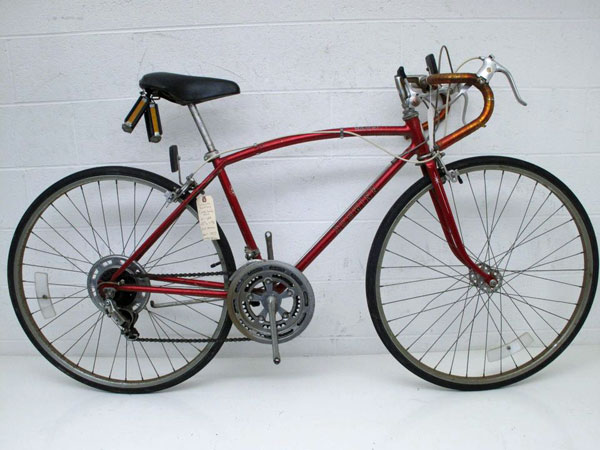
1974 Varsity Sports With Fenders Lime


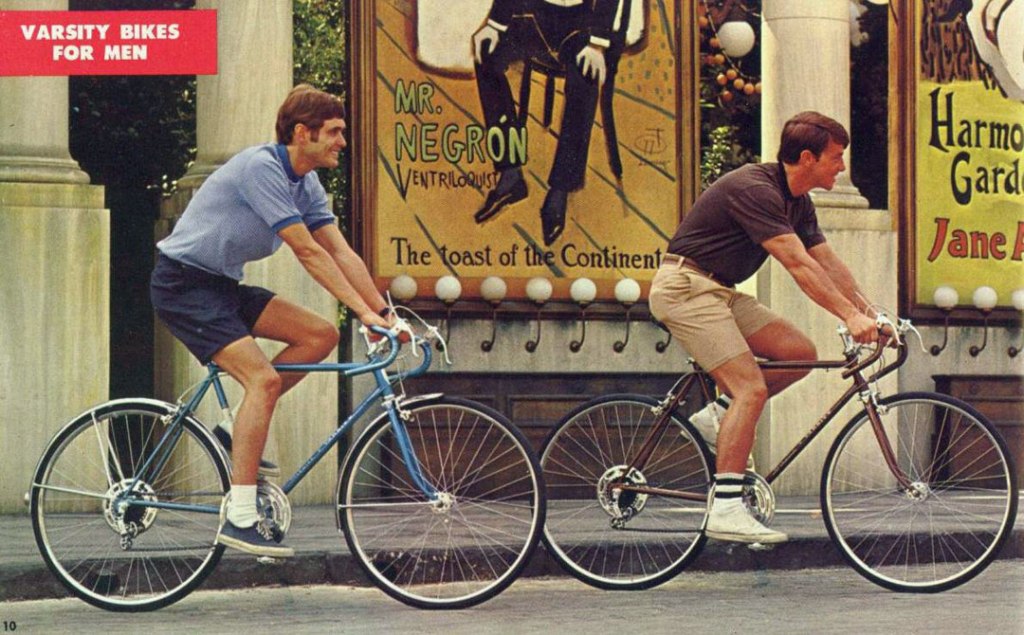
1968 Ad


Links
Schwinn Bicycle Company History
Schwinn Le Tour Guide and History
 Frugal Average Bicyclist
When I was a kid, everyone wanted a ten speed, and that meant a Schwinn Varsity. Those who couldn’t afford one got a Lenton Sports (probably actually a better bike). The rest of us just rode the family hand-me-downs.
LikeLike
I had a Lime Green Ladies’ Varsity 10-speed in the 70’s. How can I determine the year and also the frame size?
LikeLike